

Temple Tumble — the Temple as a Space of Trials and Inner Purification
The image of the temple has long been associated with transformation, discipline, and internal balance. In Temple Tumble, this idea is reinterpreted through a symbolic structure where every action reflects a personal challenge rather than a mechanical process. The temple is not presented as decoration but as a meaningful environment in which order, risk, and restraint interact. This approach turns the theme into a narrative of testing limits and restoring equilibrium.
The Symbolism of the Temple in Temple Tumble
In Temple Tumble, the temple represents a controlled space where chaos is allowed only within clearly defined boundaries. This mirrors ancient ritual architecture, where each element served a precise purpose and nothing existed without reason. The structure itself becomes a metaphor for discipline, suggesting that progress is only possible through balance and measured decisions.
The visual and conceptual elements of the temple emphasise symmetry and repetition. These qualities are traditionally linked to purification rituals, where repeated actions reinforce focus and awareness. In this context, repetition is not monotony but a method of refinement, reinforcing the idea that improvement comes from consistency rather than impulse.
By framing the experience inside a temple, Temple Tumble avoids superficial exoticism. Instead, it draws on widely recognisable cultural references connected to reflection, restraint, and testing personal resolve. This gives the theme a sense of depth that extends beyond surface-level aesthetics.
Architectural Meaning and Spatial Design
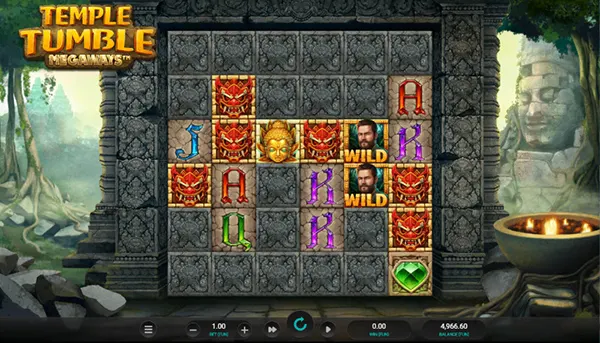
The spatial logic of the temple follows a clear vertical hierarchy, guiding attention downward and inward. Such layouts have historically been used to symbolise descent into self-examination, where each level represents a deeper stage of understanding. Temple Tumble reflects this idea by structuring progression as a gradual movement rather than abrupt change.
Stone textures, geometric patterns, and controlled lighting reinforce a sense of permanence. These elements suggest stability and endurance, reminding the observer that meaningful results require patience. Nothing in the environment feels temporary, which supports the broader narrative of long-term discipline.
This architectural coherence strengthens immersion without relying on excess detail. The restrained design language ensures that symbolism remains readable, allowing the temple to function as a conceptual framework rather than a purely decorative setting.
Trials as a Core Narrative Element
The notion of trials within Temple Tumble is rooted in the idea of measured challenge. Each stage represents a test that is neither arbitrary nor overwhelming. This reflects traditional initiation rites, where difficulty is calibrated to encourage growth rather than discourage participation.
Trials are presented as sequences that reward attention and timing. Success depends less on speed and more on understanding patterns and maintaining control. This aligns with the broader theme of self-discipline, reinforcing the idea that awareness is more valuable than haste.
By structuring challenges in this way, Temple Tumble positions trials as tools for refinement. They are not obstacles to be rushed through but moments designed to reinforce focus and composure.
Psychological Impact of Structured Challenges
Structured challenges create a psychological rhythm that encourages steady engagement. Predictable frameworks reduce cognitive overload, allowing attention to remain on decision-making rather than reaction. This design choice supports sustained concentration.
The absence of unnecessary complexity helps maintain mental clarity. Each challenge builds logically on the previous one, reinforcing confidence and reinforcing learning through repetition rather than surprise.
As a result, the trials contribute to a sense of internal order. The experience becomes less about external pressure and more about maintaining balance under controlled conditions.
Purification Through Order and Control
Purification in Temple Tumble is conveyed through order rather than spectacle. The consistent rules and predictable structure create an environment where unnecessary elements are stripped away. This reflects purification as a process of removal rather than accumulation.
Control plays a central role in this interpretation. Progress is tied to maintaining composure and resisting impulsive actions. This mirrors philosophical views in which purification is achieved through self-restraint and clarity of intention.
The overall experience encourages a measured pace. Instead of constant escalation, Temple Tumble emphasises steadiness, reinforcing the idea that purification is gradual and deliberate.
The Role of Balance in Long-Term Engagement
Balance ensures that engagement remains sustainable over time. By avoiding extremes, Temple Tumble maintains consistency, which supports long-term interest without fatigue.
This balance also reinforces trust in the system. Clear rules and predictable outcomes create a sense of fairness, which is essential for maintaining confidence and continued participation.
Ultimately, balance serves as the foundation for the theme’s credibility. It aligns the conceptual narrative with practical experience, ensuring that the idea of purification feels earned rather than implied.